


Climate Link Between Indian and Pacific Oceans Severed
· Dünya Gazetesi
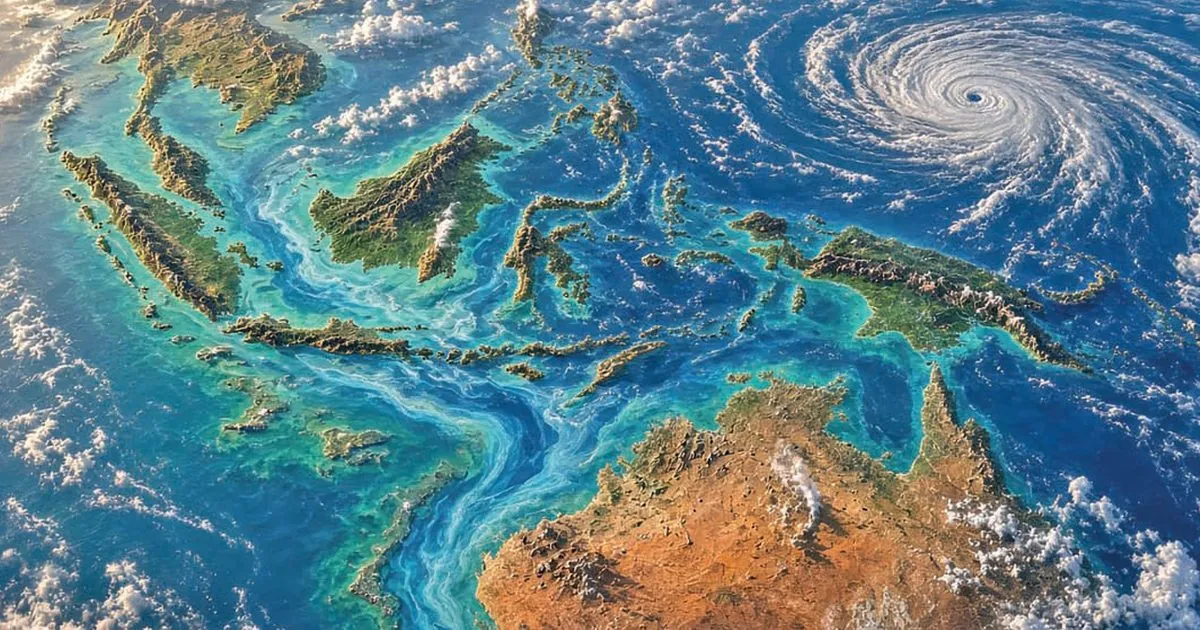
A study published in Nature Communications reveals that the 400-year climate connection between the Indian and Pacific Oceans has been broken due to human-induced greenhouse gas emissions, placing global food security at serious risk.
Centuries-Old Link Between Oceans Broken
The climatic connection between the Indian and Pacific Oceans, central to the global economy and climate balance, is experiencing its most significant rupture in history due to human-induced global warming. Research published in Nature Communications reveals that the disruption of a 400-year synchronization directly threatens agriculture, logistics, and food chains worth billions of dollars. These vast basins, covering over a third of the Earth's surface and encompassing 60% of global trade routes, served as the most critical thermal engine regulating atmospheric circulation. However, greenhouse gas emissions, which accelerated from the 1980s onwards, have completely overturned this delicate balance that has persisted for centuries.
Historical Climate Records and Research Findings
In a study conducted at the Woods Hole Oceanographic Institution (WHOI), researchers combined natural climate archives preserved in coral reefs, tree rings, and cave stalagmites with advanced climate modeling simulations. The paleoclimatological data obtained clearly showed that the two ocean basins have moved in parallel since the early 1600s. In the past, major tropical volcanic eruptions between 1810 and 1850 were found to have only temporarily weakened this link. The current process, however, was determined to be much deeper and more permanent than historical volcanic impacts, with human-induced emissions fundamentally severing the inter-oceanic variability connection.
Threat to Agricultural Yields and Food Security
The disruption of inter-oceanic synchronization is not limited to meteorological changes but also exerts heavy pressure on global agricultural production and food security. The unpredictability of temperature and rainfall regimes in tropical regions carries a significant risk of causing severe harvest losses, particularly in Southeast Asia, Australia, and East Africa. While devastating drought crises deepen in East Africa, erratic monsoon rains across Australia and Asia are directly disrupting planting and harvesting schedules. Sharp declines in agricultural product supply are expected to trigger significant fluctuations in global commodity and food prices.
Dr. Kristopher Karnauskas's Climate Warnings
Evaluating the research findings, Dr. Kristopher Karnauskas, a researcher at the Woods Hole Oceanographic Institution, issued the following warnings:
'The climatic link between the Indian and Pacific Oceans is one of the most fundamental regulators of the planet's atmospheric circulation. The breakdown of this centuries-long synchronization eliminates the predictability our models are accustomed to. Human-induced warming is literally cutting off communication between the oceans, overriding nature's own natural cycles.'
Dr. Caroline Ummenhofer's Risk Assessment
Focusing on the historical perspective offered by ocean archives, WHOI Paleoclimatology Expert Dr. Caroline Ummenhofer made the following statement regarding the scale of the disruption:
'Our 400 years of data from corals and tree rings show that even the massive volcanic eruptions in the 1800s could only cause temporary breaks in this connection. However, the weakening we have observed since the 1980s is beyond a natural cycle; it is a permanent and extraordinary deviation triggered entirely by greenhouse gas emissions. This situation harbors very serious risks for global food and water security.'
Supply Chains and Future Risks
The weakening of atmospheric and oceanic interaction creates a critical breaking point not only for agriculture but also for fishing activities and maritime logistics. Changes that could not be verified due to the limited historical record of reliable instrumental data, only going back a century, have now been confirmed with this 400-year comprehensive climate map. The complete severance of the link between the two oceans over the last 40 years brings with it climate disasters that could lead to billions of dollars in additional costs for global commodity trade and port logistics. The loss of predictable weather conditions for producers and decision-makers necessitates the development of new strategies for sustainable food supply.
Global Trade and Ocean Climate Indicators
Source: WHOI · Period: 1600'lerden günümüze
- Global trade routes ratio
- 60% Ratio / Duration
- Climatic synchronization duration
- 400 years (since 1600s) Ratio / Duration