


Fresh Fruit and Vegetable Exports Decline in Volume, Increase in Revenue
· Tarım Dünyası
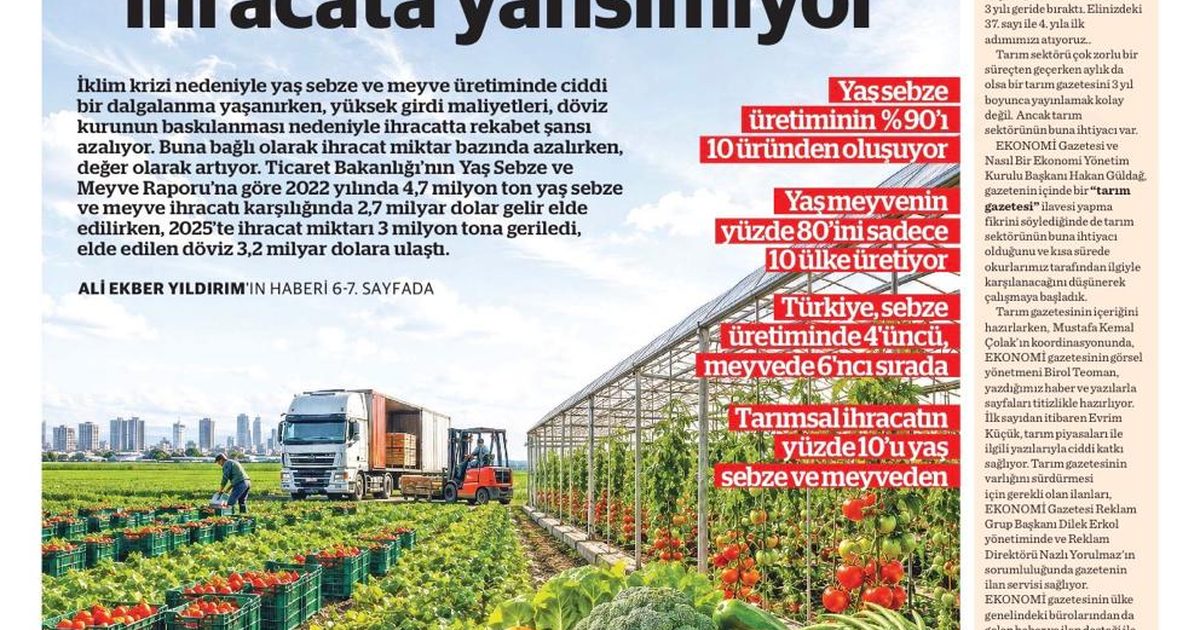
Turkey's fresh fruit and vegetable exports saw a volume decrease from 4.7 million tons in 2022 to 3 million tons by 2025, while total foreign exchange revenue reached $3.2 billion.
Divergence in Export Volume and Value
While Turkey's fresh fruit and vegetable sector maintains its production capacity strength, a significant divergence is occurring in its foreign trade balance in terms of volume and revenue. According to Ministry of Trade data, in 2022, $2.7 billion in revenue was generated from the export of 4.7 million tons of fresh vegetables and fruits. By 2025, the volume of exported products decreased to 3 million tons, while foreign exchange revenue increased to $3.2 billion. This decline in tonnage directly impacts producer incomes and on-the-ground marketing balances.
Input Costs and Competitive Pressure
High input costs and foreign exchange rate policies are weakening the competitive power of Turkish producers in international markets. The U.S. Department of Agriculture (USDA) report on Stone Fruits indicates that despite a recovery in fresh cherry and peach exports, Turkish producers are struggling against competitors like Spain, Italy, and Iran. Yield fluctuations due to the climate crisis and high on-farm costs make it difficult for producers to earn profits and also bring the risk of losing customers in foreign markets. This situation poses a risk to the sector's sustainability.
Global Fresh Vegetable Production Balance
According to Food and Agriculture Organization of the United Nations (FAOSTAT) data, global fresh vegetable production continues its steady growth. Global vegetable supply, which was 1.174 billion tons in 2023, increased by 1.7% to 1.194 billion tons in 2024. The top 10 products, accounting for 90% of the total production, reached a volume of 1.07 billion tons. Potatoes ranked first with a share of 390.4 million tons, followed by tomatoes with 195.0 million tons, onions with 116.3 million tons, cucumbers with 99.2 million tons, and cabbage with 72.5 million tons.
Turkey's Position in Global Fresh Vegetable Rankings
The concentration of countries in global vegetable production has reached remarkable levels. According to FAO data, China single-handedly managed 54.4% of the global market in 2024 with its production of 649.8 million tons. Following China, India produced 142.5 million tons, and the USA produced 31.9 million tons. Turkey ranked 4th in the world with a production volume of 31.6 million tons and a global share of 2.65%. The total production of the top 10 countries constituted 84.5% of the world's supply with 1.009 billion tons, while other countries accounted for 185 million tons.
Global Fresh Fruit Production Pattern
Global fresh fruit production continues its upward trend in parallel with increasing demand. According to FAOSTAT data, the world's fresh fruit harvest, which was 929 million tons in 2023, increased by 1.6% to 945 million tons in 2024. The total volume of the top 10 most produced fruits reached 712 million tons, constituting 75% of global production. Bananas ranked highest with 137.6 million tons, followed by watermelon with 105.4 million tons, apples with 98.1 million tons, oranges with 79.3 million tons, and grapes with 78.5 million tons.
Country Shares in the Global Fruit Sector
The top 10 countries in global fruit production hold 80% of the global volume with a total production of 760 million tons. China maintained its leadership in fruits with a production of 325 million tons and a 34.4% share, while India produced 118 million tons, Brazil 45 million tons, the USA 39 million tons, and Indonesia 28 million tons. According to FAO data, Turkey ranked 6th in global fresh fruit production with a production volume of approximately 27 million tons and a global share of 2.9%, solidifying its position as a strategic supplier.
Turkey's Diversity Advantage from its Climate
The Fresh Fruit and Vegetable Sector Report published by the Ministry of Trade highlights Turkey's broad ecological structure and market position with the following statements:
"Plant production is a fundamental and strategic area of the Turkish agricultural sector, with fresh fruit and vegetable products being among its most dynamic components. Thanks to Turkey's diverse climate and ecological conditions, it is possible to cultivate subtropical and some tropical products in addition to temperate climate products. Turkey is among the important producer and exporter countries in the global fresh fruit and vegetable trade. Particularly in fresh fig production and export, Turkey holds a strong position, with varieties such as the 'Bursa Black' grown in Bursa and the 'Mut Fig' grown in the Mut region standing out in international markets for their quality and aroma characteristics. Cucumbers are an important vegetable product traditionally grown in Turkish greenhouse cultivation. The variety known as 'crispy cucumber' is in high demand in international markets due to its juicy texture, aroma, and shelf-life advantages."
Modern Greenhouse Cultivation and Quality Standards
Continuous year-round production of products such as tomatoes, peppers, eggplants, and zucchini is ensured through modern greenhouse investments and technological production infrastructure. These facilities guarantee supply continuity in exports, while the increasing demand for organic farming creates new markets for Turkey. To compete internationally, Turkish exporters implement quality and food safety certifications such as ISO 9001, ISO 22000, HACCP, and GLOBALG.A.P. This institutionalization of quality standards enhances the added value of products and reinforces the profile of a reliable supplier in international trade.
Impact of 2025 Frost on Yield
According to TurkStat data, severe frost events and adverse weather conditions in 2025 caused significant losses in fruit yield. Fresh fruit production decreased by 30.9% compared to the previous year, falling to 19.6 million tons, with sharp declines observed in apples, peaches, nectarines, and cherries. Vegetable production remained at 33.3 million tons, a decrease of 0.9%. Within the vegetable group, tomato production fell by 7.6% to 13.5 million tons. While cucumber production saw a limited decrease, eggplant and zucchini production increased.
Export Revenues from Citrus and Tomatoes
Fresh fruit and vegetable exports, which account for 10% of total agricultural export revenue, reached $3.2 billion in 2025, a 1.3% increase. According to Ministry of Trade data, the citrus group became the locomotive of exports with $1.5 billion in revenue. Mandarin exports, with the Satsuma variety standing out, generated $950 million, while lemon exports, with Interdonato and Lamas varieties, brought in $413 million. Tomatoes, one of the sector's most critical export items, accounted for 12.5% of total exports with a value of $402.4 million.
Demand and Targets in International Markets
The Turkish fresh fruit and vegetable sector currently ships products to over 120 countries and free zones. Iraq, the Russian Federation, Germany, Romania, and Ukraine are prominent buyer markets for exports. Recently, a significant acceleration in demand for mandarins, peppers, and pomegranates has been recorded, while Sultana grapes maintain their global popularity for table consumption. Traditional flavors like Turkish figs and quinces are also steadily increasing their share in foreign markets due to their high aroma.