


Minister Yumaklı Announces Forest Fire Data
· Tarım ve Orman Bakanlığı
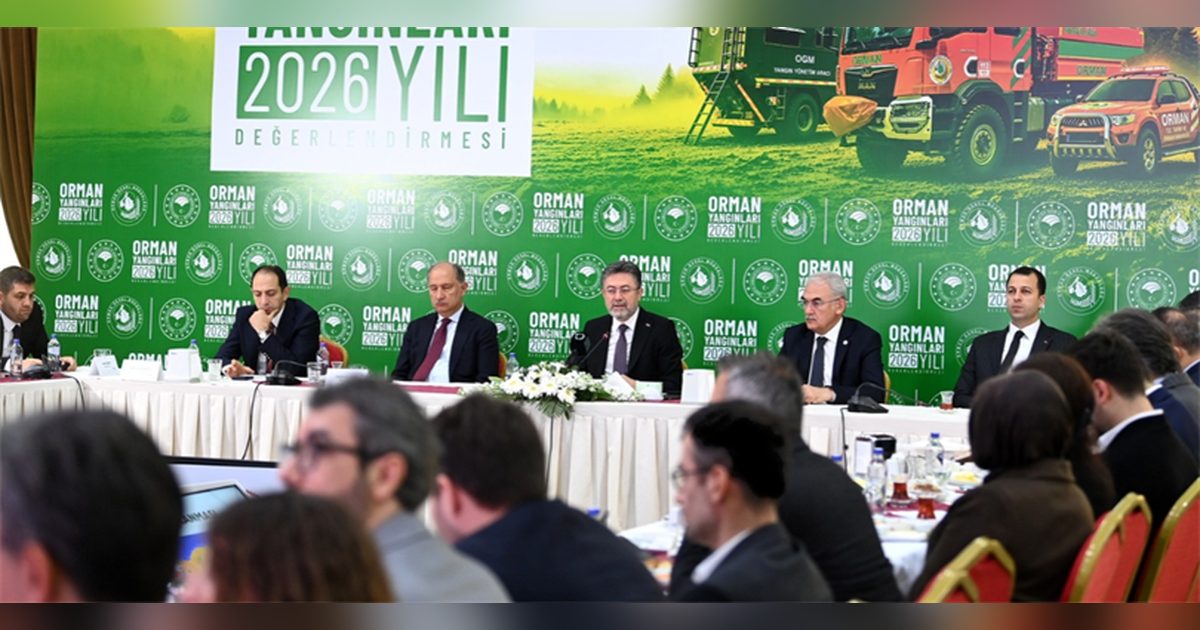
Minister of Agriculture and Forestry İbrahim Yumaklı announced that the number of forest fires decreased by 35% and the damaged forest area by 68% in 2026, sharing new steps in fleet and early warning systems.
Preventive Measures in Firefighting
Minister of Agriculture and Forestry İbrahim Yumaklı shared the forest organization's 2026 fire balance sheet and ongoing efforts with the public at a comprehensive press conference held in Istanbul. According to the ministry's statement, the approach to protecting forest assets is not limited to interventions after a fire breaks out but encompasses a holistic risk management and preventive measures chain. Addressing the importance of prevention strategies and civil participation at the meeting, Minister of Agriculture and Forestry İbrahim Yumaklı stated:
'The first stage of our work consists of training, awareness-raising, and preventive measures. Within the understanding of the 'Green Homeland Mobilization,' we are making all segments of society a part of this struggle. One of our greatest sources of strength in this fight is our forest fire volunteers. We increased our volunteer numbers from 13,000 in 2021 to 142,000 in 2026. With our 'My Forest' campaign, we clean forests of glass, plastic, and similar waste that could cause fires before summer begins, together with our youth and children. By opening new fire safety roads and strips, we both reduce the risk of fire spread and facilitate the access of our teams to fire zones. This year, we built 56 new fire pools and ponds, bringing the total number to 4,852. These pools play a critical role in the water access of our aerial firefighting assets in challenging terrains. Today, we have 776 fire observation towers nationwide. Of these, 194 serve as smart observation towers.'
According to information shared by the ministry, these preparations against forest fires provide a critical logistical support mechanism, especially in rural basins where the terrain is rugged and access for ground teams is difficult, through fire pools and ponds.
Intervention Fleet and Infrastructure
To increase the intervention capacity within the General Directorate of Forestry, ground vehicles and aerial fleets have been expanded simultaneously. Drawing attention to the increase in the number of personnel working in the field and the distribution of deployed ground vehicles, Minister of Agriculture and Forestry İbrahim Yumaklı shared the following information:
'We increased the number of forest fire fighting personnel from 25,000 in 2025 to 28,065 in 2026. We increased our number of fire trucks to 1,953, our first response vehicles to 2,766, and our heavy machinery to 878. These teams are deployed at 1,600 different points.'
Minister of Agriculture and Forestry İbrahim Yumaklı, detailing the technological transformation in the aerial fleet and the historical development of aerial intervention capabilities, continued his remarks:
'In 2026, we increased our aircraft numbers to 28 and our helicopter numbers to 119. We increased our instantaneous water-dropping capacity from 73 tons in 2002 to 462 tons in 2026. With our 14 Bayraktar TB2 unmanned aerial vehicles, we monitor our forests and detect fires early. We increased our aerial vehicle deployment locations to 69 in 2026 with the addition of 11 new points.'
It was noted that thanks to the integration of aerial and ground assets, the reaction times of teams from the moment they receive a fire report have been shortened, and the intervention range has been expanded with vehicles strategically positioned.
Technology and Early Warning
Minister Yumaklı stated that 64% of Turkey's forest assets are located in geographically sensitive fire zones, emphasizing that the Enhanced Fire Risk Map and AI-supported decision systems are actively used in the field. Describing the digital applications integrated under the Forest Fire Management System, Minister of Agriculture and Forestry İbrahim Yumaklı made the following assessment:
'With these maps, which evaluate more than 40 parameters, we sent special warnings to our forest management chiefdoms 7 days in advance on high-risk days. We also directed our aerial vehicles and ground teams to areas where the risk was concentrated. With the newly developed forest road navigation system, we enabled fire trucks to reach fire areas faster. By integrating sensors into our fire trucks and water supply vehicles, we monitored temperature, humidity, and wind data in real-time. We installed secure driver recognition systems in our vehicles. We distributed location tracking devices for safety purposes to our personnel in fire-sensitive areas. We consolidated all these different software and tracking systems under the Forest Fire Management System. This year has been a year where we implemented many innovations in AI-supported systems, software, and technological infrastructure, and derived maximum benefit from them in firefighting.'
This developed integrated digital network allows meteorological data to be matched with field vehicle sensors, enabling the prediction of fire spread direction in advance.
Annual Fire Statistics Comparison
According to official records presented by the ministry, a total of 7,509 fires occurred across Turkey in 2025, with 3,224 in forest areas and 4,285 in rural areas. Summarizing the interventions in 2026 and the annual decline, Minister of Agriculture and Forestry İbrahim Yumaklı announced the following data:
'This year, we intervened in a total of 6,219 fires, 2,111 of which were in forests and 4,108 in rural areas. There was a 35% decrease in the number of forest fires compared to the previous year.'
Pointing out that 75% of the fires started outside forest boundaries, Minister Yumaklı shared the early extinguishment rates and the extent of damaged areas:
'24,527 hectares of our forest area were affected by fires. There was approximately a 68% decrease in the forest area burned compared to the previous year. Of the 2,111 forest fires that occurred in 2026, 1,766 were brought under control in areas smaller than one hectare. We brought 96% under control in areas smaller than 10 hectares.'<
The ministry's data showed that thanks to the coordinated work of ground and air assets, fires were contained in small areas without spreading to large forest masses.
Human Factor and Meteorology
When examining the causes of forest fires, human negligence and accidents were found to be by far the leading factor. Sharing the detailed statistical distribution and critical weather conditions experienced during the summer months with the public, Minister of Agriculture and Forestry İbrahim Yumaklı provided the following information:
'86% of fires were caused by human factors. 67% were due to negligence and carelessness, 16% due to accidents, 3% due to intentional acts, and 14% due to lightning. In 2026, we had acute periods in two timeframes. The first was between July 29-31. During this 3-day period, we responded to a total of 260 fires. While we brought 255 of these fires under control before they spread, 5 fires became prominent in public discourse. Similarly, we experienced an intense fire period between September 7-8. In 2 days, we responded to a total of 147 fires. The most challenging factor in fires was wind. For example, in Gömeç, Balıkesir, the wind speed reached 63 kilometers per hour. In Çine, Aydın, only 12% humidity accelerated fire spread. The area damaged as a result of fires in these two acute periods constituted 80% of the total damaged area.'
It was stated that the risk of fire spread peaked on days when low relative humidity and storm-force wind speeds combined, and the majority of the total damaged forest area occurred within these short time windows.
Area Comparison with International Data
International fire statistics were also discussed at the meeting. It was reported that in 2026, 692,419 hectares of forest area were affected by fires across the European Union, and while there was a 33% decrease in the total burned area in EU countries compared to the previous period, the decline in Turkey was 68%. Yumaklı shared the ratio of burned areas to the total forest assets of countries; this ratio was recorded as 1.24% in Canada, 1.23% in the USA, 1.09% in Spain, 1.06% in Portugal and Italy, 0.56% in France, and 0.54% in neighboring Greece. Evaluating Turkey's position in this table, Minister of Agriculture and Forestry İbrahim Yumaklı said:

'Our country is at a much lower rate than all these countries, at 0.1%.'
Minister Yumaklı added that while Turkey conducts its own struggle, it also shows cross-border solidarity, and in this context, provided firefighting aircraft and helicopter support to Spain and France.
Afforestation and Carbon Sink Forests
Yumaklı reiterated that the forest areas damaged are under the guarantee of the Constitution of the Republic of Turkey and can never be opened for construction or any other activity. He noted that the burned areas will be promptly rehabilitated and transformed into new carbon sink areas. Announcing the upcoming afforestation calendar, Minister of Agriculture and Forestry İbrahim Yumaklı stated:
'In this context, we are starting the establishment of new carbon sink forests without delay. We have been celebrating November 11 as National Afforestation Day since 2019. This year, on November 11, at the COP31 Summit in Antalya, our President Recep Tayyip Erdoğan, Australian Prime Minister Albanese, and United Nations Secretary-General Guterres will plant saplings together. While the leaders plant saplings in the Peace Forest we established in commemoration of COP31, we will bring our saplings together with the soil with our citizens in 81 provinces under the slogan 'Breathe for the Future, Peace for the World.' We invite all our citizens, from 7 to 70, to the sapling planting sites in their provinces on November 11. Citizens can also easily undertake sapling adoption or donation through our 'Breathe for the Future' website, as they have done every year. Under the leadership of our President, we will continue to work to increase greenery and entrust our forests to future generations in the strongest way possible.'
It was announced that sapling adoption portals are kept open for citizen participation in the mobilization, and sapling planting sites are being prepared nationwide.
Introduction of the Turquoise Connectivity Initiative
Addressing the preparations for the 31st Conference of the Parties to the United Nations Framework Convention on Climate Change (COP31), which Turkey will host in Antalya, Minister Yumaklı emphasized that water management will play a key role in making agricultural and food systems resilient to climate pressures. Minister of Agriculture and Forestry İbrahim Yumaklı announced the following:
'Our pioneering approach, which places water at the center, is closely followed and emulated by many countries. In this context, we will officially launch the Turquoise Connectivity Initiative at the Round Table Meeting, which we will hold with the participation of international organizations and guest ministers. With this vision, which is based on the connectivity of water, energy, food, and ecosystems, we will present a global model that addresses crises holistically and generates solutions.'
The initiative's main goal is to build an integrated environmental policy that connects the sustainable management of water resources with the loops of energy and food security.
Rural Development and Food Security
Yumaklı stated that food supply security, the zero-waste approach, and the protection of agricultural supply chains will form the backbone of the summit's agenda, and that a technical report prepared in partnership with the International Fund for Agricultural Development (IFAD) will be presented to the world public. Summarizing the ministry's global goals, Minister of Agriculture and Forestry İbrahim Yumaklı concluded his remarks as follows:
'We will transform our deep-rooted experience in preventing food waste into a global action plan that will spread throughout the world. With the Regional Center of Excellence to be established, we will make Turkey a global hub for recording food waste data and providing policy and measurement guidance. To strengthen the role of women and young farmers in agriculture, we will activate international dialogue mechanisms with the 'High-Level Dialogue of Women Farmers' and 'High-Level Dialogue of Young Farmers' events, again in Antalya. We will lead the 'High-Level Dialogue on Integrated Fire Management' within the scope of the global fight against forest fires. With our solution-oriented agricultural diplomacy at COP31, we will once again declare Turkey's global leadership in sustainable agriculture, water, and forest management to the entire world.'
Forest Fire Fighting Fleet and Equipment Numbers (2026)
Ministry of Agriculture and Forestry
- First response vehicle
- 2,766 unit
- Water tanker
- 1,953 unit
- Construction machinery
- 878 unit
- Fire observation tower
- 776 unit
- Smart observation tower
- 194 unit
- Helicopter
- 119 unit
- Airplane
- 28 unit
- Bayraktar TB2 UAV
- 14 unit