


Yield Increase Adds 65 Liters of Oil Per Ton of Olives
· TarımTR
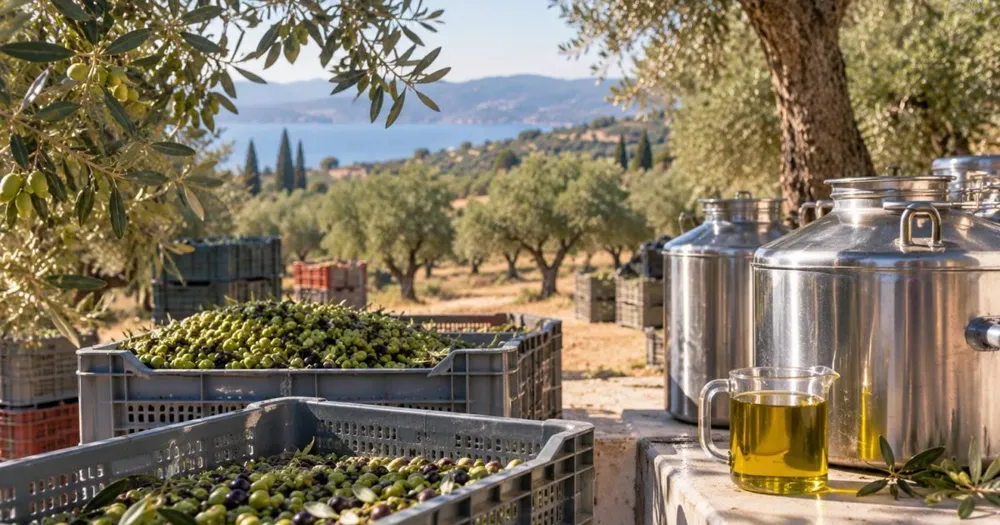
Technical calculations ahead of the olive harvest indicate that a 6% increase in yield provides an additional 65 liters of oil per ton of olives, directly impacting producer income.
Balance of Yield and Output in Olives
As the olive harvest season approaches, the primary concern for producers is the pressing yield and the final amount of product to be obtained. According to technical studies conducted by the Ministry of Agriculture and Forestry, olive oil yield across Turkey generally varies between 14% and 20% depending on the year. The variety of olive, the region where it is grown, the maturity level of the fruit, and seasonal climate conditions directly determine the volume of oil obtained. Therefore, even products harvested from the same grove can offer vastly different yield levels at different times.
Oil Calculation Based on Percentage Rates
Calculations based on the average density coefficient of olive oil, which is 0.916 kg/liter, clearly show the yield from 1 ton of olives. At a 14% yield, approximately 153 liters of olive oil, equivalent to 140 kilograms, are obtained from 1,000 kilograms of olives. When the yield is 15%, 164 liters are obtained; at an 18% level, approximately 197 liters of olive oil, equivalent to 180 kilograms, are extracted. Under conditions where the yield rises to 20%, 218 liters of olive oil, equivalent to 200 kilograms, are achieved. A 22% yield provides 220 kilograms, and a 25% yield provides 250 kilograms of oil.
Direct Impact of Yield Difference on Income
For the producer, the monetary value of 1 ton of olives is not limited solely to the raw sale price of the product on a kilogram basis. According to technical comparisons, there is a significant production difference of 65 liters between a 14% yield and a 20% yield. This difference, arising from the same amount of olives, can completely alter the producer's gross income statement, depending on the market selling price of the olive oil. Therefore, producers must fully consider the yield factor when deciding to convert olives into oil rather than selling them as whole fruit.
Impact of Harvest Timing on Oil Quantity
As the fruit matures, the oil accumulation in olives continuously increases up to a certain stage. However, expert organizations state that delaying the harvest does not always bring absolute profit. Technical data from the Ministry of Agriculture and Forestry indicate that oil olives should be harvested when there are no green fruits left on the tree and the oil content has reached its peak. If the harvest is delayed more than necessary, fruit quality rapidly declines, leading to commercial losses such as increased acidity and product loss.
Balance Between Quality and Yield
Achieving the highest oil yield in olive cultivation does not always mean producing the highest quality olive oil. Although olives pressed during the early harvest period yield a lower volume of oil in liters, the sensory and chemical properties of the resulting product are superior. Evaluations by the Aydın Provincial Directorate of Agriculture and Forestry indicate that olive oil quality is directly dependent on the waiting period after harvest, as well as the harvest timing. The producer's primary goal should be to establish an optimal balance between quality and quantity, not just high volume.
Pressing Process and Correct Practices
The time it takes for harvested products to reach the factory and the pressing techniques applied at the facility directly affect the total yield and quality. The Aydın Provincial Directorate of Agriculture and Forestry emphasizes the critical importance of quickly sending olives for pressing after harvest without delay. Preventing the product from coming into contact with the soil and avoiding damage during collection preserves oil quality by preventing oxidation. The operating efficiency of modern continuous systems in the factory and the pressing temperature are also among the factors affecting the final liter quantity obtained from 1 ton of olives.
Strategic Steps to Increase Producer Income
Producers benefit greatly from regularly monitoring the maturity of different plots in their groves before the harvest season. Where possible, conducting yield analysis in a laboratory environment before harvest facilitates the selection of the most appropriate harvest day. The decision of whether to sell the product as raw material or convert it into olive oil should be made in light of this data. Through correct harvesting techniques, appropriate storage containers, and timely pressing, both oil losses are prevented, and the producer's seasonal commercial income is secured.
1 Ton Zeytinden Elde Edilen Yağ Miktarı
Tarım ve Orman Bakanlığı Verileri
- Yüzde 14 Randıman
- 153 Litre
- Yüzde 15 Randıman
- 164 Litre
- Yüzde 18 Randıman
- 197 Litre
- Yüzde 20 Randıman
- 218 Litre