


Soaring Input Costs Double Wheat Per-Decare Costs
· TarımTR
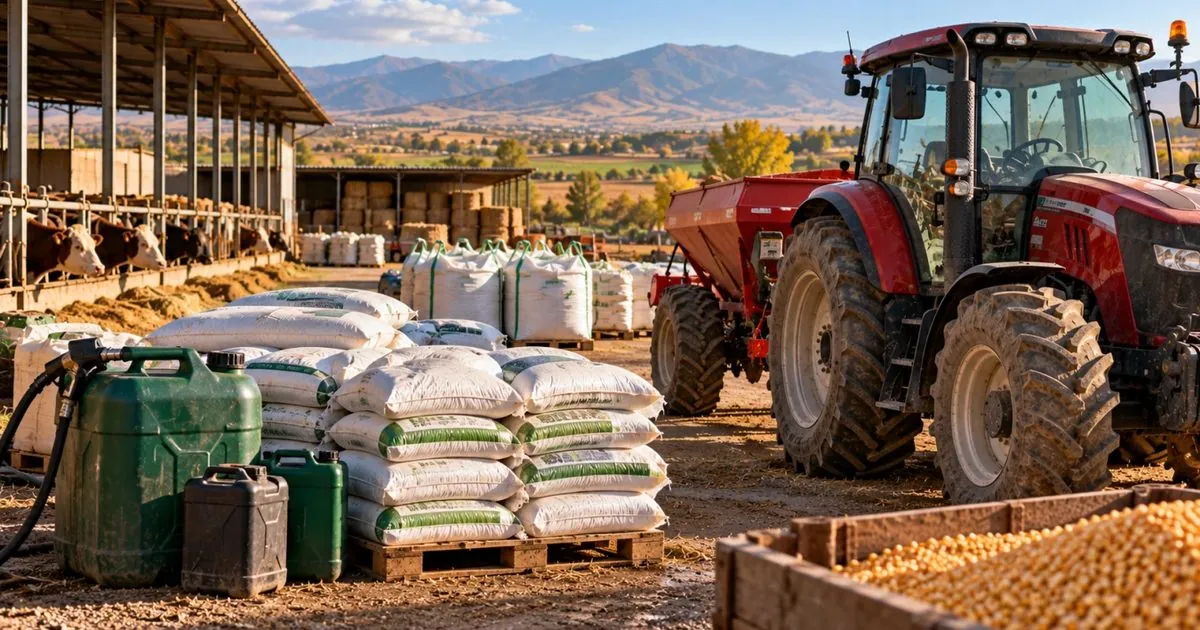
Wheat producers entering the new planting season face expenses exceeding 7,000 to 8,000 Turkish Lira per decare due to rapidly rising input costs, particularly for diesel and fertilizer.
As the wheat planting season begins across Turkey, producers' attention has turned to input expenditures in the field. This process, starting with land preparation, seed procurement, and base fertilization, shows a significant upward trend in production costs. During field operations, which accelerated as of October, farmers are meticulously calculating all operational items to ensure a profitable season. Initial data from Turkey's various agricultural basins clearly indicate that per-decare expenses are shaping up at considerably high levels compared to previous seasons.
Regional cost studies reveal that figures vary according to geographical conditions. In a 2026 study prepared by the Adana Farmers' Association, the gross production cost was calculated at 7,093.08 TL per decare, assuming a yield of 480 kilograms per decare. After deducting support payments, the net cost was 5,867.08 TL. In the Thrace region, the Lalapaşa Agricultural Chamber announced a total cost of 8,443 TL and a per-kilogram cost of 21.10 TL, based on a yield of 400 kilograms per decare. These calculations include land rent, labor, depreciation, and financing expenses.
The most critical factor straining farmers' budgets in the new planting period has been the sharp rise in diesel and fertilizer prices. According to TZOB data, the price of diesel per liter rose to 94.60 TL in the September 2026 period, marking a 12.8% increase month-on-month and a 70.7% increase year-on-year. During the same period, the price of DAP fertilizer, one of the base fertilizers, reached 48,356 TL per ton, showing a 9.9% increase over two months. Urea fertilizer was sold at 29,158 TL/ton, and 20.20.0 compound fertilizer at 31,279 TL/ton.
Sowing norms and seed selection are among the primary factors directly affecting per-decare costs. According to research sources from the Ministry of Agriculture and Forestry, the thousand-grain weight, germination rate, and tillering capacity of wheat varieties necessitate different seed quantities. While standard wheat varieties require 18-20 kilograms of seed per decare, this need increases to 20-22 kilograms per decare for large-grained varieties. Therefore, instead of assuming a fixed seed cost for all of Turkey, varietal characteristics on a parcel basis should be considered.

Wheat production involves numerous hidden cost items, extending from plowing the field to harvesting, not just seeds and chemical fertilizers. Soil cultivation, the use of sowing machinery, weed and rust control applications, irrigation energy, and combine harvester and transportation fees during the harvest period increase the total expenditure. Furthermore, a significant gap emerges between the per-decare costs of a producer cultivating their own land and a farmer growing wheat on rented land, paying high rental fees.
The Turkish Grain Board (TMO) announced the purchase price for 2nd group bread and durum wheat for 2026 as 16,500 TL per ton, or 16.50 TL per kilogram. The Ministry of Agriculture and Forestry determined a total payment of 979.60 TL per decare within the scope of basic support, planned production support, and certified seed support. Calculating support income at 3,014 TL per ton based on the national average yield, the theoretical income reaches 19,514 TL/ton. However, support conditions vary for each producer.
The most fundamental variable determining the producer's profitability threshold is the yield obtained per decare. A producer harvesting 400 kilograms of wheat per decare earns a gross income of 6,600 TL per decare when selling their product at TMO's purchase price of 16.50 TL. This income may fall short of the gross cost of 7,093 TL in Adana and the total cost of 8,443 TL in Lalapaşa. However, when the parcel yield increases to 500 kilograms, fixed costs are spread out, whereas at a yield level of 300 kilograms, the unit cost rapidly increases.
Wheat producers preparing for sowing must create a realistic operational budget based on current market conditions. Farmers calculating diesel and fertilizer at current market prices should also include end-of-season expenses such as harvesting and transportation in their plans. For sustainable production in the sector, it is crucial for farmers to not only calculate the money spent per decare but also to pre-calculate how many kilograms of product they need to obtain per decare to reach the break-even point and to act based on soil analysis in input usage.
| Value | Period | Measure |
|---|---|---|
| 7093.08 TL/da | 2026 | Adana wheat gross production cost |
| 5867.08 TL/da | 2026 | Adana wheat net production cost |
| 480 kg/da | 2026 | Adana default wheat yield |
| 8443 TL/da | 2026 | Lalapaşa total production cost |
| 21.1 TL/kg | 2026 | Lalapaşa kilogram cost |
| 400 kg/da | 2026 | Lalapaşa default wheat yield |
| 94.6 TL/litre | September 2026 | Diesel liter price |
| 12.8% | September 2026 | Diesel monthly price increase rate |
| 70.7% | September 2026 | Diesel annual price increase rate |
| 48356 TL/ton | September 2026 | DAP fertilizer ton price |
| 9.9% | August-September 2026 | DAP fertilizer two-month increase rate |
| 29158 TL/ton | September 2026 | Urea fertilizer ton price |
| 31279 TL/ton | September 2026 | 20.20.0 fertilizer ton price |
| 18-20 kg/da | 2026 | Standard seed sowing rate |
| 20-22 kg/da | 2026 | Large grain seed sowing rate |
| 16500 TL/ton | 2026 | TMO wheat purchase price |
| 979.6 TL/da | 2026 | Total support per decare |
| 3014 TL/ton | 2026 | Support equivalent per ton |
| 19514 TL/ton | 2026 | Theoretical income including support |
| 6600 TL/da | 2026 | Gross product income at 400 kg yield |