


Egypt Gains Ground in Global Markets with Agricultural Production Surge
· Tarım Dünyası
Egypt is emerging as a strong competitor in Turkey's traditional export markets by increasing its agricultural added value through large-scale irrigation projects, subsidized financing models, and its fertilizer production capacity.
Structural Transformation in Egyptian Agriculture
The 'Egypt Agriculture and Food Industry Market Research Report,' prepared by the Commercial Counselor's Office of the Turkish Ministry of Trade in Cairo, reveals Egypt's agricultural production strength and its increasing competitiveness in global markets.
The report from the Commercial Counselor's Office of the Turkish Ministry of Trade in Cairo outlines the historical development and macroeconomic significance of Egyptian agriculture with the following statements:
"In this context, the construction of the High Dam, which began in 1960, and the subsequent comprehensive land reclamation and irrigation projects have played a decisive role in the sector's transformation. Although the share of arable land within Egypt's total land area is around 4%, one of the lowest globally, the agricultural sector maintains its strategic importance. The agricultural sector's share in Egypt's Gross Domestic Product (GDP) for the fiscal year 2024/2025 is 15%, employing approximately a quarter of the country's workforce, rates that are higher than those in OECD countries."
This structural transformation makes Egypt a significant competitor for Turkey in fresh fruit and vegetable exports.
Increase in Agriculture's Gross Value Added
According to data from the Egyptian Ministry of Planning and Economic Development, the gross value added (GVA) at producer prices in Egypt for the fiscal year 2024/2025 was 17.4 trillion Egyptian Pounds (approximately 362 billion USD) at current prices. The total GVA, which was 13.2 trillion EGP in the previous fiscal year 2023/2024, showed a nominal increase of 31.4%.
In the same period, the GVA of the agricultural sector grew from 1.9 trillion EGP to 3.0 trillion EGP, marking a much stronger nominal leap of 57.47%. As a result of this dynamism, the agricultural sector's share in the total economy rose from 14.4% to 17.3% within a year.
Reclamation Projects Expanding Cultivated Areas
Egypt's move to expand its limited agricultural land is directly reflected in official data.
The Commercial Counselor's Office of the Turkish Ministry of Trade conveys the land reclamation targets and contract farming plans in the report with the following words:
"According to Egypt State Information Service-SIS data, Egypt's total cultivated area increased from 8.9 million feddans (3.7 million hectares) in 2014 to 10 million feddans (4.2 million hectares) in 2024. While the aim is to increase the total cultivated area to over 21 million feddans (8.8 million hectares) through reclamation and irrigation projects, the contract farming system is also planned to be expanded to cover 1.8 million feddans (756 thousand hectares), including not only wheat, sugarcane, sugar beet, tomatoes, potatoes, and citrus fruits, but also oilseeds such as corn, cotton, sunflower, and soybeans. Furthermore, diversification of supply sources for import-dependent products, especially wheat and corn, and increasing wheat storage capacity to 5.5 million tons are planned."
Significant State Support for Irrigation Infrastructure
In Egypt, which receives almost no rainfall outside its Mediterranean coast, agricultural production relies entirely on modern irrigation management. The government, accelerating state support, approved a subsidized credit package of 120 billion EGP in March 2024 for agriculture, renewable energy, and free zone manufacturers.
This financing model, with an interest rate of 15%, well below market conditions, continues in 2025 at 90 billion EGP. Additionally, 144.8 billion EGP has been allocated for agriculture and irrigation investments within the framework of the 2025/2026 fiscal year development plan. The aim is to increase agricultural product yields by 5% to 10% through the widespread adoption of drip and pivot irrigation.
Reclaiming Desert Areas with New Delta
The Egyptian government aims to create 4 to 4.5 million feddans of new agricultural land by 2027 to ensure food security by bringing desert areas into production. The New Delta Project, forming the largest part of this policy, is being carried out in the western and northwestern regions of the country.
Within the scope of the project, it is planned to reclaim 2.2 million feddans (924 thousand hectares) of land in the Western Nile Delta, thereby expanding the country's total agricultural area by 15%. In this massive project, with a total investment of 800 billion EGP (approximately 15.1 billion USD), the land development cost per feddan ranges between 350,000 and 400,000 EGP.
Strategic Power in Global Fertilizer Exports
Egypt has become a regional hub for fertilizer production, which is a critical component of agricultural input costs. The country's annual fertilizer production capacity stands at 18-19 million tons, while domestic consumption needs are only around 4 million tons.
Offering its production surplus to world markets, Egypt has become a global leader in nitrogenous fertilizer exports, ranking tenth worldwide with a 2.2% share. This situation provides Egyptian producers with a significant cost advantage, while the country maintains high import dependency for certain strategic staple products such as wheat, corn, edible oil, and legumes.
High-Volume Horticultural Production Range
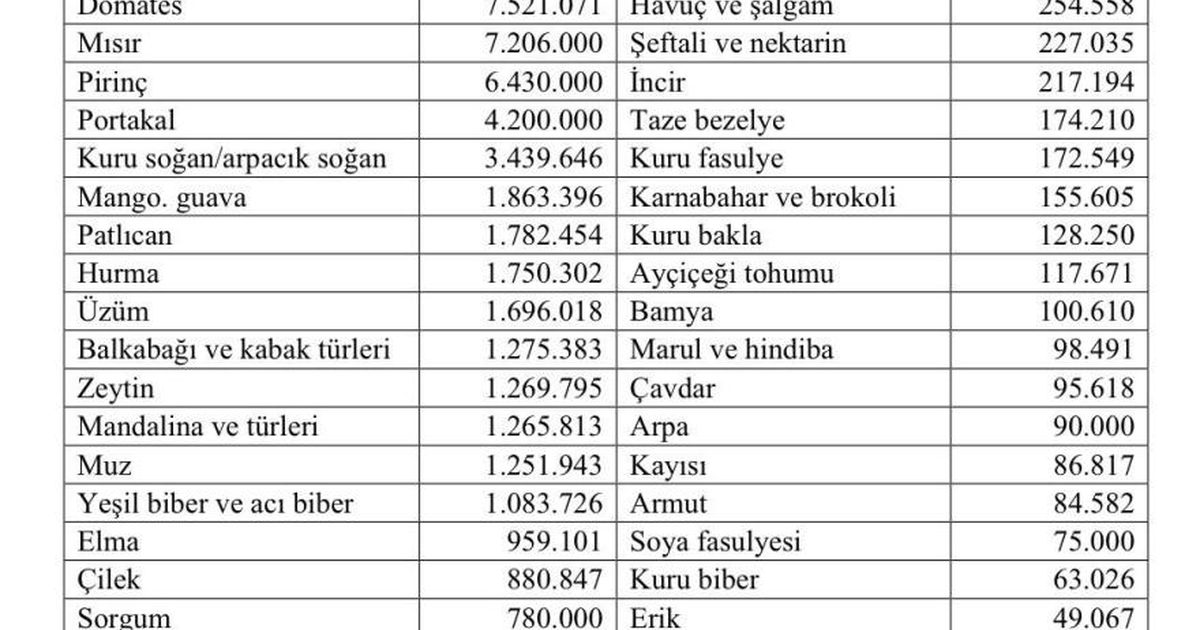
Examining Egypt's horticultural production pattern, high tonnages are notable in industrial and staple consumption products. Sugar beet production in the country reaches 13.9 million tons, and sugarcane production reaches 13.3 million tons, forming the main inputs for the food industry.
Wheat production, central to basic food security, is 9.4 million tons. In the vegetable group, potato production at 8.1 million tons and tomato production at 7.5 million tons offer an uninterrupted supply chain. Egypt also maintains a balance between feed and food by producing 7.2 million tons of corn and 6.4 million tons of rice.
Strengthening Competitive Advantage in Fruit Exports
Egypt is increasing its competitiveness in global fruit production markets, particularly aiming for world leadership in the citrus sector. Producing 4.2 million tons of oranges annually, the country has secured a significant share in Turkey's traditional markets for global fresh fruit exports.
Furthermore, the production of 1.75 million tons of dates and 1.86 million tons of mango and guava groups reflects Egypt's tropical climate advantage. In the vegetable group, 3.4 million tons of dry onions and 1.78 million tons of eggplant are produced. In oilseeds, 273 thousand tons of peanuts, 118 thousand tons of sunflower, and 75 thousand tons of soybeans are produced, with continued external dependency in this area.
Price Controls Curbing Food Inflation
Food inflation, which reached a historical peak of 73.6% in September 2023, has been reduced to 4.6% as of February 2026 through strict measures implemented. A Prime Ministry Decree dated December 2023 declared liquid oil, beans, rice, milk, sugar, pasta, and white cheese as strategic products, prohibiting their stockpiling and mandating maximum retail prices (MRP).
Market inspections have been tightened, with fines and prison sentences imposed on violators. Additionally, 160 billion EGP (approximately 3.2 billion USD) has been allocated in the 2025/2026 budget for food subsidies, providing subsidized bread to two-thirds of the population.
Regional Food Industry Investment Moves
Egypt aims to increase the size of its food industry to 30.5 billion USD by 2026, with the goal of processing agricultural products into value-added food industries. For this purpose, MAFI for Agricultural Produce Industries, a private free zone company, has been established in the Industria industrial zone in Sadat city, Menoufiya Governorate.
This integrated facility, established with a total investment of 180 million USD, handles the drying, freezing, and packaging of agricultural products. The processed foods produced are targeted for direct export to the European Union, US, and Gulf countries' markets.
Export Threshold of 11 Billion Dollars
Egypt's exports of agricultural and food industry products reached 11.2 billion USD in 2025, with the top 20 countries accounting for 70% of total exports. Middle Eastern, Gulf, and African countries lead in exports, while the European Union is a strategic market for value-added products.
Turkey, with its agricultural and food imports of 270.5 million dollars from Egypt, holds a 2.4% share. Egypt's favorable energy, low labor costs, and logistical advantages are increasingly enhancing its effectiveness in Turkish exporters' traditional markets for fresh and processed products.
National Livestock and Aquaculture Drive
Egypt has increased its livestock population by 6.7% to 8.1 million heads in 2024 as part of its National Livestock Development Strategy, launched to achieve self-sufficiency in local breed improvement and meat-milk production. The number of slaughtered animals reached 4.4 million heads, and total red meat production increased by 16% to 754 thousand tons.
Raw milk production rose by 15.7% to 6.6 million tons, while poultry meat production reached 2.4 million tons, and egg production amounted to 16.6 billion units. With an annual aquaculture production of 2 million tons, Egypt ranks first in Africa and first globally in tilapia production.