


THE RESPONSIBILITY OF COMMON SENSE IN WORKING LIFE AND TRILATERAL CONSULTATION
· Halil ETYEMEZ
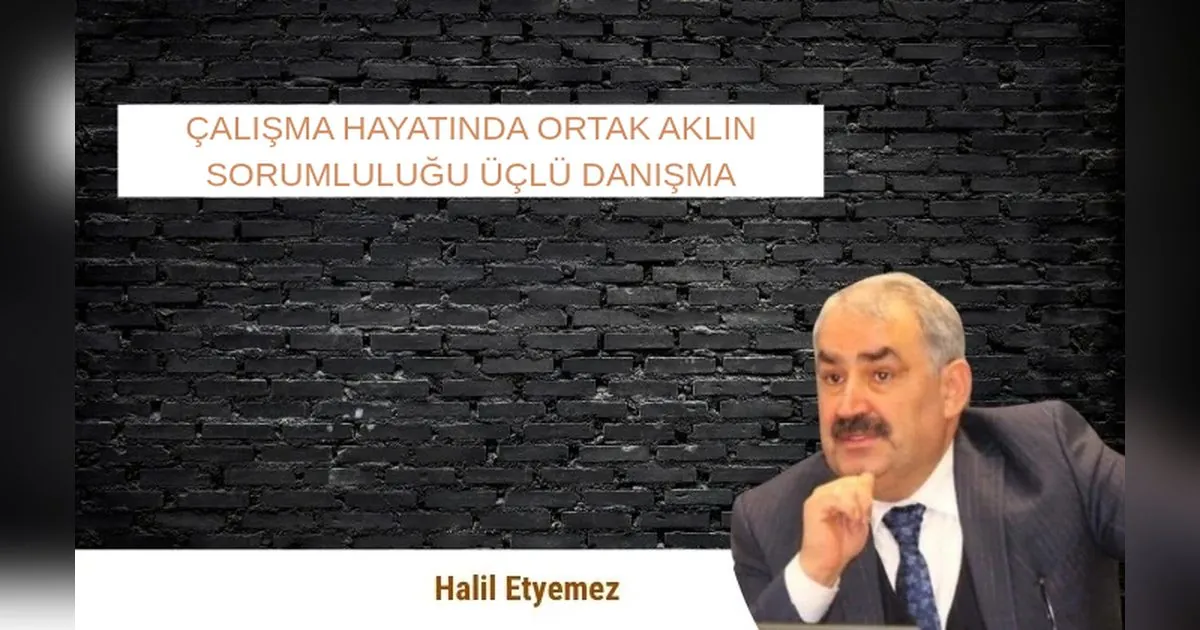
The Trilateral Consultation Board, bringing together public administration, employees, and employers, is a crucial institutional structure for regular dialogue on issues affecting working life, production, and family futures. A recent meeting highlighted the need for this platform amidst evolving work methods and technological advancements.

Every decision made in working life affects the livelihood of the employee, the production of the business, and the future of the family. Therefore, regular consultation between public administration, employees, and employers is of great importance. The Trilateral Consultation Board is the institutional structure that brings these three parties to the same table.
The board, convened by the Ministry of Labor and Social Security on October 6, 2026, with the agenda of 'New Working Methods in Working Life,' reminded us of this need again. Representatives from TÜRK-İŞ, HAK-İŞ, DİSK, and TİSK participated in the meeting chaired by the Minister of Labor and Social Security.
The legal basis of the Board is Article 114 of the Labor Law No. 4857, dated 2003. The working procedures were regulated by a regulation published on April 4, 2004, and its first meeting was held on May 24, 2004, under the chairmanship of the then Minister of Labor and Social Security.
The term 'trilateral' refers to the public, employee, and employer sectors. Employee and employer confederations are represented along with the Ministry and relevant institutions. The regulation also provides for the participation of public official confederations; separate or joint meetings can be held depending on the agenda.
At this table, labor legislation, employment, union relations, and practical problems are evaluated. Parties share their demands, develop solution proposals; and technical working groups are formed when necessary. Indeed, following the 2023 meeting, groups related to labor laws became active in January 2024.
The fundamental point to be understood about the nature of the Board is this: The Trilateral Consultation Board is an advisory body. It can form a common opinion and make working decisions; however, its recommendations do not automatically replace laws or regulations. For binding implementation, authorized authorities must take the necessary legal actions separately. Discussing an issue does not mean that a change has been made on that subject.
On the other hand, its regular convening is a legal requirement. The regulation foresees three meetings a year in January, May, and September; it also allows for extraordinary meetings. The absence of specific penalties for not convening does not eliminate this obligation. There have been interruptions in practice, and the Ministry announced that the October 2023 meeting was held after a five-year hiatus.
The Board's impact lies in its ability to bring the parties' knowledge and experience into regulatory preparations, to identify problems early, and to build trust. My experience in union management, public administration, and legislation shows that consultation yields results through preparation and follow-up.
Today, this table faces a rapidly changing world of work. Remote and hybrid work, taking jobs through digital platforms, and project-based work create different needs. The working hour limits for those working from home, the counterpart for platform workers, and the continuity of income and social security at the end of a project await clarification.
As we prepare for the transformation driven by technology and artificial intelligence, we must equip employees with new skills and support individuals whose jobs are changing in their transition to new professions. We should evaluate the success of new models based on wages, security, and working conditions, along with employment figures.
The global trend also affects this agenda. According to SIPRI, global military spending rose for the eleventh consecutive year in 2025. We must plan the human resource needs arising from defense and advanced technology investments in conjunction with vocational training and employment policies. We must ensure that investments strengthening national security translate into qualified and secure jobs.
Within this framework, our recommendation is that the board should meet regularly, the responsible institution and work calendar should be determined at each meeting, and the results should be evaluated at the subsequent meeting. New working models should also be continuously monitored through technical studies; appropriate practices should be tested according to the conditions of the sectors.
In every model, wage predictability, continuity of social security, and the right to rest must be protected. Women's employment should be supported with care services, and youth participation with vocational development and opportunities for transition to permanent employment.
Unions should also carry their rights advocacy into the digital working life. The protection of employee data, the limits of digital surveillance, and the possibility of human oversight and objection in work decisions made by artificial intelligence should be included in the collective bargaining agenda. The increase in productivity provided by technology should also be reflected in the welfare of the employees.
The labor and future of the working human being is a trust for everyone who carries management responsibility. The success of trilateral consultation should be visible in the reward for hard work, in peace at the workplace, and in the security of the individual's future. As working methods change, human dignity and the right to labor must be strengthened.
May you forgive my shortcomings.
May you be entrusted to God.