


Raw Milk Reference Price Stalemate Pressures Producers
· Tarım Dünyası
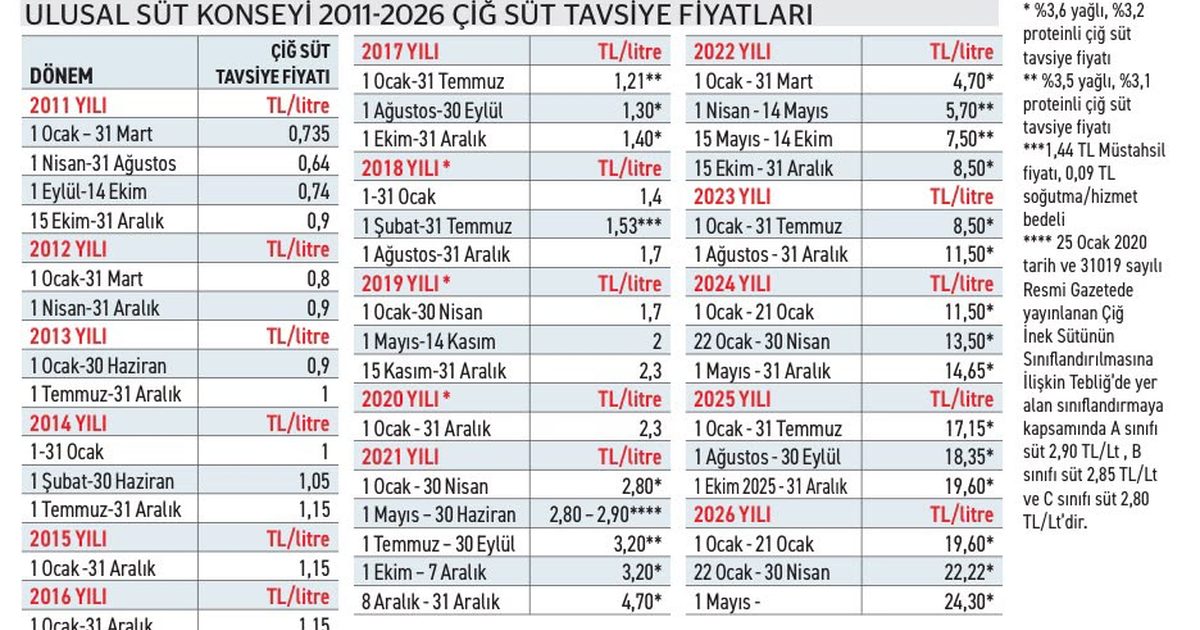
With input costs soaring in the free market, the six-month-old fixed raw milk reference price has pushed producers to the brink of bankruptcy and withdrawal from production.
Chronic Crisis in Milk Price Determination Mechanism
Looking at the last 30 years, the determination of raw milk prices in Turkey's livestock sector has consistently led to crises. While the selling price of raw milk produced by farmers is determined under public control, the inputs used by farmers, especially feed, are priced under free market conditions. Producers of drinking milk, yogurt, cheese, and butter made from raw milk can also set their sales prices independently. The producer segment, deprived of the right to determine the price of their own product, constantly faces losses due to systemic imbalance.
Establishment and Structure of the National Milk Council
The National Milk Council (USK) was established by a regulation published in the Official Gazette dated September 23, 2008, to resolve the price confusion in the sector. The council officially commenced operations after its Founding Board convened on January 26, 2009, to determine the interim management. Prior to this, prices were determined through an auction method between Köy-Koop Union and industrialists. However, as this auction method faltered, the idea of bringing the public, industrialists, and producers to a common platform was implemented. Despite this, the council's lack of market intervention and enforcement power has deepened structural problems.
Insufficient Producer Representation on the Board of Directors
The Board of Directors of the National Milk Council consists of a total of 12 members, with three representatives from four different sub-groups. While the industrialist, public, civil society, and academic sub-groups constitute nine members, the producer sub-group is represented by only 3 members. Due to this arithmetic structure, industrialists, bureaucrats, and academics form the majority at the table that determines the value of the milk produced by farmers. While industrialists seek to reduce their costs, representatives from the Ministry of Treasury and Finance resist demands for increases in favor of producers, citing the need to avoid triggering inflation.
Transfer of Authority to the Food Committee in 2018
The Central Bank's first inflation report in 2018, which identified raw milk price increases as a key driver of food inflation, created a fundamental shift. Then-Deputy Prime Minister for Economic Affairs, Mehmet Şimşek, expressed his discomfort with the increase in the raw milk reference price from 1.30 TL to 1.40 TL, and subsequently to 1.53 TL in January. Under pressure from the economic management, which argued for adherence to the fight against inflation, the price-setting authority was transferred to the Food Committee, operating under the coordination of the Central Bank, rendering the council's decision-making mechanism dysfunctional.
Price Suppression Policy and Months of Fixed Prices
With a regulation from the Ministry of Food, Agriculture, and Livestock published in the Official Gazette on January 31, 2018, the reference price was made subject to the approval of the Food Committee. Under the pretext of curbing inflation, the raw milk reference price was kept fixed for a full 11 months between August 15, 2018, and April 30, 2019. The National Milk Council, which became merely a body that announced the price determined by the Food Committee to the public for approximately 3.5 years, was pushed into a position where it could not even regularly implement the routine price update schedule that should have been done quarterly.
Implementation of Standard Production Contracts and the Issue of Bindingness
The General Directorate of Livestock under the Ministry of Agriculture and Forestry officially implemented raw milk production contracts within the scope of the 2025 Animal Production Standard Contract. Although the contract offers pricing criteria based on product quality, parity, or negotiation, it does not draw a clear framework. The regulation includes the provision, 'the price determined according to the specified parameters cannot under any circumstances be below the advisory price announced by the National Milk Council.' However, the lack of full compliance with these contracts in the field and insufficient oversight continue to allow milk purchases below the advisory price from producers.
Reference Milk Price Kept Fixed for Six Months
The raw milk reference price of 24.30 TL, set by the National Milk Council effective from May 1, 2026, has not been changed for 6 months. While the milk price remains stagnant, the compound feed and other main inputs used by producers are subject to price increases almost every week. The uncontrolled price surge in input markets has completely disrupted cost calculations. The failure to update the advisory price has disrupted the cash flow of businesses and pushed milk production to an unsustainable economic threshold.
TÜSEDAD's Reaction to the Delay
The Board of Directors of the All Milk, Meat, and Holstein Cattle Breeders Association (TÜSEDAD) has called for an urgent update of the reference price, making the following statement regarding the delay:

'Although a common approach was adopted at the Milk Workshop held by the Ministry of Agriculture and Forestry and the National Milk Council to evaluate the raw milk advisory price on a quarterly basis, the announcement that the price valid from May 1 would be kept fixed and re-evaluated in October, and the lack of any announcement to date, has caused significant dissatisfaction among producers.'
Retail Shelf Prices Soar While Producers Are Pressured
While the raw milk payments to farmers are frozen due to inflation concerns, retail prices for milk and dairy products are constantly increasing. Pointing to this deep contradiction in the sector, the TÜSEDAD Board of Directors shared the following assessment with the public:
'While price increases faced by consumers in drinking milk, white cheese, yogurt, and other dairy products continue, the fact that the income of raw milk producers is not increasing has become a fundamental contradiction in the sector. It is clearly seen that suppressing producer prices in the name of fighting inflation is not yielding results. Keeping producer prices fixed neither prevents increases in shelf prices nor protects the consumer. On the contrary, this approach increases the risk of milk producers withdrawing from production.'
Decline in Feed Sales and Businesses' Struggle for Survival
A decline of 15% to 20% in feed sales compared to the previous period is documented across the sector. Drawing attention to the seriousness of the situation on the ground, the TÜSEDAD Board of Directors expressed the dilemma faced by producers in the following words:
'This decline in feed sales indicates that producers are forced to feed their animals not for productivity, but merely at a level that allows them to survive. In other words, many businesses are now aiming not to increase production, but to keep their businesses afloat. This is a clear indicator of the difficult conditions under which milk producers are operating and shows that the necessary price update should not be delayed any further.'
Postponement of USK Meeting and Increasing Input Pressure
No price decision was reached at the online meeting of the National Milk Council held on October 30, 2026, and the session was postponed. İlhan Köten, Chairman of the Central Union of Turkish Holstein Cattle Breeders, provided the following information about the background of the meeting:
'On October 30, at 11:00 AM, we held a Zoom meeting with the National Milk Council (USK), where I am on the board. As a result of the evaluations made during the meeting, no announcement was made regarding the raw milk price, and it was decided to postpone the decision to a meeting to be held next week. However, as producer representatives, we brought not only the raw milk price but also the fundamental issues that directly affect the future of our sector and require urgent solutions to the agenda.'
Criticizing the pressure created by fluctuations in the feed market and its relationship with milk prices, İlhan Köten, Chairman of the Central Union of Turkish Holstein Cattle Breeders, concluded his remarks as follows:
'The uncontrolled increase in feed prices and the timing mismatch with milk prices. Today, feed costs are among the most significant problems in the livestock sector. While feed prices are increased almost every week, our producers are facing increasing difficulties in the face of these increases. We see that especially in small family businesses, it is difficult to meet the nutritional needs of the animals due to the pressure of feed costs. In some businesses, we even witness animals being fed only at a level that covers their subsistence needs. The result of this is a decrease in milk yield, a loss in production, and the endangerment of the sustainability of businesses. On the other hand, when a new raw milk price is announced by the National Milk Council, the increase in feed prices on the same day or immediately after causes serious justified anger among our producers. Before the producer can start earning income from the newly announced milk price, feed prices are increased, thus a significant portion of the price increase is taken back before it even reaches the producer's pocket. Therefore, it is essential for price formation in the feed market to be transparent and predictable.'
| Value | Period | Measure |
|---|---|---|
| 12 members | 2009-2026 | Total number of board members of the National Milk Council |
| 3 members | 2009-2026 | Number of raw milk producer representatives on the board |
| 1.4 TL/litre | September 2017 | September 2017 raw milk reference price |
| 1.53 TL/litre | January 2018 | January 2018 raw milk reference price |
| 11 months | 15 August 2018 - 30 April 2019 | Continuous period during which the raw milk reference price was kept constant |
| 3.5 years | Post-2018 | Length of the period during which the Food Committee directly set the price |
| 24.3 TL/litre | 1 May 2026 | Current raw milk reference price |
| 6 months | May - October 2026 | Current period during which the milk recommendation price was kept constant |
| 15% | 2026 | Annual decline rate in feed sales |