


Ministry Updates Disease-Free Herd Criteria
· Tarım Dünyası
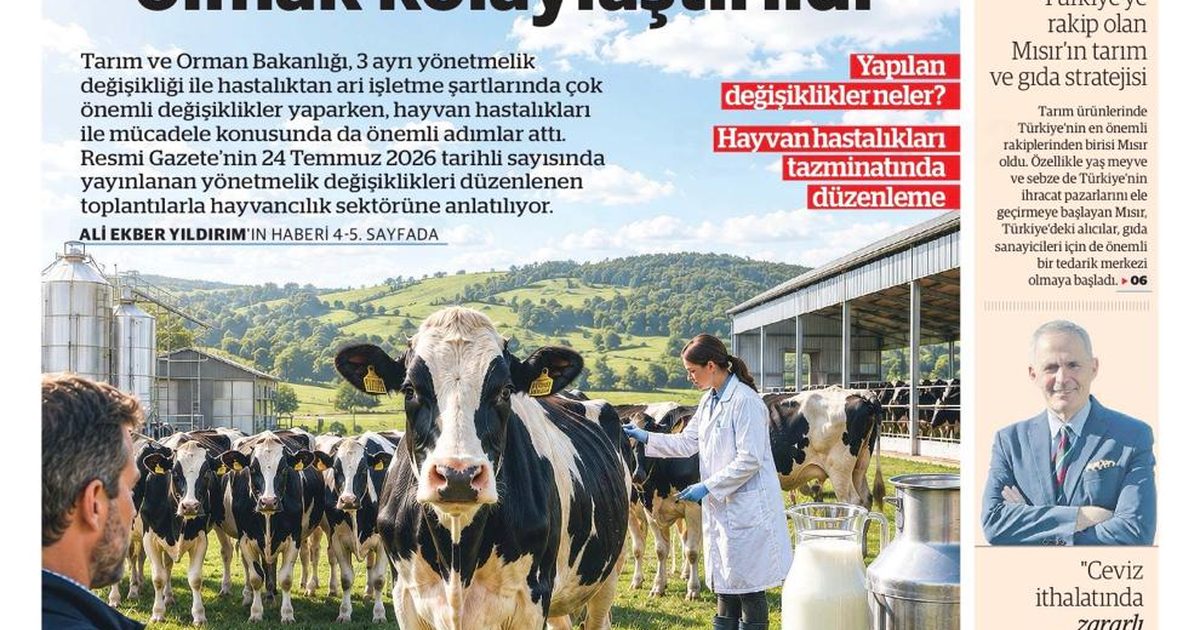
The Ministry of Agriculture and Forestry has shortened certification processes for disease-free herds by amending three separate regulations, reducing bureaucratic hurdles and certificate cancellations.
New Era Begins for Disease-Free Herds
The Ministry of Agriculture and Forestry has made comprehensive changes to three separate regulations to ensure sustainability in the livestock sector and guarantee animal health. The new regulations, published in the Official Gazette on July 24, 2026, and effective immediately, have fundamentally updated the criteria for disease-free herds, particularly in dairy farming. This move, following certificate cancellations and industry debates in Bursa in June, aims to prevent bureaucratic hardships for producers. The Ministry is implementing much more flexible and rational criteria in combating animal diseases.
Critical Update on Brucellosis Test Age
With the amendment to the Brucellosis Control Regulation published in the Official Gazette, diagnostic methods, quarantine rules, and disease-free status criteria for cattle, sheep, and goats have been entirely renewed. The lower age limit for cattle testing for brucellosis, previously defined as under 30 months in the legislation, has been revised by the Ministry of Agriculture and Forestry to over 12 months. To achieve disease-free status, all cattle over 12 months must yield negative results in two consecutive tests after infected animals are removed from the herd.
Herd Monitoring and Suspicion Protocol
If a brucella infection is bacteriologically confirmed in the herd as a result of laboratory examinations, the disease outbreak will be immediately declared, and the herd's disease-free status will be canceled. The herd will be placed under close monitoring for 30 days, and if no further cases are observed, the disease will be officially considered eradicated. However, if only seropositive animals are detected, the certificate will not be immediately canceled; only a suspicion annotation will be placed on the herd. If no adverse events occur during the 30-day suspicion period, the suspicion will be lifted, and the certificate will be renewed if negative results are obtained in two tests conducted 30 days apart.
New Compensation Rates for Animal Diseases
The amendment to the Animal Disease Compensation Regulation has clarified the conditions for compensation for animals sent for mandatory slaughter or destroyed due to tuberculosis and brucellosis. According to the Ministry's statement, 90% of the appraised value of cattle, sheep, and goats whose diseases are confirmed by tuberculin or bacteriological tests will be paid to the producer. The same compensation rate will apply to animals that die during quarantine with suspicious results. For cattle carcasses with detected tuberculosis at slaughterhouses or Eid al-Adha slaughter sites, 75% of their value will be paid to the producer as compensation.
New Criteria in Bovine Tuberculosis Control
The update to the Bovine Tuberculosis Control Regulation introduces significant technical flexibility in diagnostic methods, herd classification, and quarantine practices. The testing periods applied for herd-based monitoring of the disease have been shortened, easing the waiting time for producers. The first test will be conducted at least 42 days after the removal of the last positive reactor from the herd through slaughter or death, and the second test 42 days after that, totaling 84 days. The minimum waiting period between the two tests, previously 60 days, has been reduced to 42 days, accelerating the process.
Achieving Disease-Free Status and Isolation in Tuberculosis
When new animals are introduced into a herd that is not disease-free, two tests must be conducted at intervals of at least 6 months and at most 12 months. During this period, complete isolation conditions will be required to prevent contact between incoming animals and the disease-free herd. If tuberculosis is detected after slaughter or in the laboratory, the status will be canceled, and the first test will be applied within a maximum of 7 business days after the last positive case is removed. In case of a positive reactor in routine tests, the certificate will not be canceled; only a suspicion of disease will be noted, and the situation will be clarified through two tests conducted within an 84-day period.
Durations for Disease-Free Certification Significantly Shortened
The new model, implemented by the General Directorate of Livestock, prevents unnecessary certificate cancellations and avoids production losses for farms. When brucellosis is detected due to abortions, the recovery period for the certificate has been reduced from 6 months to 2 months. If a reaction is observed in routine blood tests, the certificate will not be canceled and will be updated after a 2-month follow-up. In cases of tuberculosis detection at the slaughterhouse, the follow-up period has been reduced from 4 months to 84 days, while bureaucratic processes that previously took up to 12 months for routine skin tests have been completely eliminated and replaced by a total 84-day testing schedule.
Preventive Measures Before Risk Arises
Ministry officials explain the fundamental philosophy of the new model as strengthening preventive measures before risks arise, rather than intervening after risks have occurred. By increasing biosecurity standards, the resistance of farms to external factors and epidemics will be systematically enhanced. Disease-free herds will now be monitored using continuous and risk-focused modern surveillance techniques. Processes will become much more transparent for producers through official controls based on standard and objective criteria. Thus, in addition to animal health, the efficiency of national production and food safety will be guaranteed.
Agricultural Supports for Disease-Free Herds
Only 1% of the over 1 million cattle operations across Turkey hold a disease-free certificate. To increase this rate, agricultural supports provided to disease-free herds are significantly increasing. While the basic support per calf for 2026 is applied at 1400 Turkish Lira, disease-free herds benefit from an additional support of 4 times the amount per female calf. Standard operations receive 20 kurus per liter for raw milk support, while disease-free operations receive 60 kurus. An additional coefficient of 0.6 support is provided for EU-approved dairy farms.
Financing, Insurance, and Commercial Advantages
Producers with disease-free herd certificates gain access to extensive opportunities in agricultural financing and insurance. Interest rate reductions ranging from 70% to 100% are granted to disease-free herds for livestock loans subsidized by the Treasury and provided by Ziraat Bank. Businesses can benefit from an upper limit of 80 million Turkish Lira for investment and operating loans. Producers who achieve high added value in breeding stock sales benefit from a 15% premium discount on TARSIM Animal Life Insurance policies, while also obtaining direct permits for disease-free raw milk and in-herd embryo production.
Deputy Minister Gümen's Vision Assessment
Deputy Minister of Agriculture and Forestry, Prof. Dr. Ahmet Gümen, made the following assessment regarding the implemented legislative changes and the new certification model:
We are implementing a new model for disease-free herd certification. With practices that reduce the burden on our producers, strengthen animal health, and accelerate processes; we are significantly shortening certification processes. We are strengthening preventive animal health with a risk-focused and scientific approach. We are increasing producer participation in the process through voluntary testing applications. We are resolutely continuing our work for the sustainability of our livestock sector and the protection of our producers' labor. Disease-free herds are the most solid guarantee of strong livestock and reliable food production. We are resolutely expanding this model, which provides more support, stronger financing, lower insurance costs, and higher added value to our producers. Healthy herds, strong production, reliable food; this is the livestock vision of the Century of Turkey.
Regional Information Meetings Continue Unabated
Following the enactment of the new regulations, the General Directorate of Livestock has begun regional meetings to inform provincial organizations and producers. After the first meeting chaired by General Director of Livestock Salih Çelik in Ankara, extensive workshops were held in Balıkesir and Kırklareli. Personnel from Bursa, Çanakkale, and Balıkesir participated in the session in Balıkesir, while teams from Edirne, Istanbul, Kırklareli, and Tekirdağ convened in Kırklareli. In the second sessions, technical experts met directly with disease-free herd owners, explaining the field applications and advantages of the new certification model and sharing the goal of widespread adoption of the process.