


Sunflower Production Rises, But Import Dependency Persists
· GıdaTarım

While sunflower harvests are projected to increase due to expanding cultivation areas benefiting from drought resistance, rising costs and heavy imports are intensifying pressure on domestic producers.
Sunflower has achieved strategic importance with the inclusion of oilseed crops in Turkey's production planning. Water scarcity linked to the climate crisis is accelerating the shift towards sunflowers, which consume less water compared to corn and cotton. Under current conditions, approximately 70% of production is maintained on rain-fed dry agricultural lands, with irrigated farming accounting for only 30%. Alongside traditional production centers in Thrace and Marmara, cultivation areas are significantly expanding in the Aegean, Central, and Southeastern Anatolia regions.
Despite rising input costs, low purchase prices and intensive import practices are negatively impacting producers' income stability. It is stated that if the unfinished dam projects in the Thrace region are completed and transition to irrigated agriculture, the country could end its import dependency on Russia and Ukraine. However, current pricing and import preferences continue to suppress the market share of domestic producers. Supporting production within a planning framework has the potential to directly ensure domestic supply security.
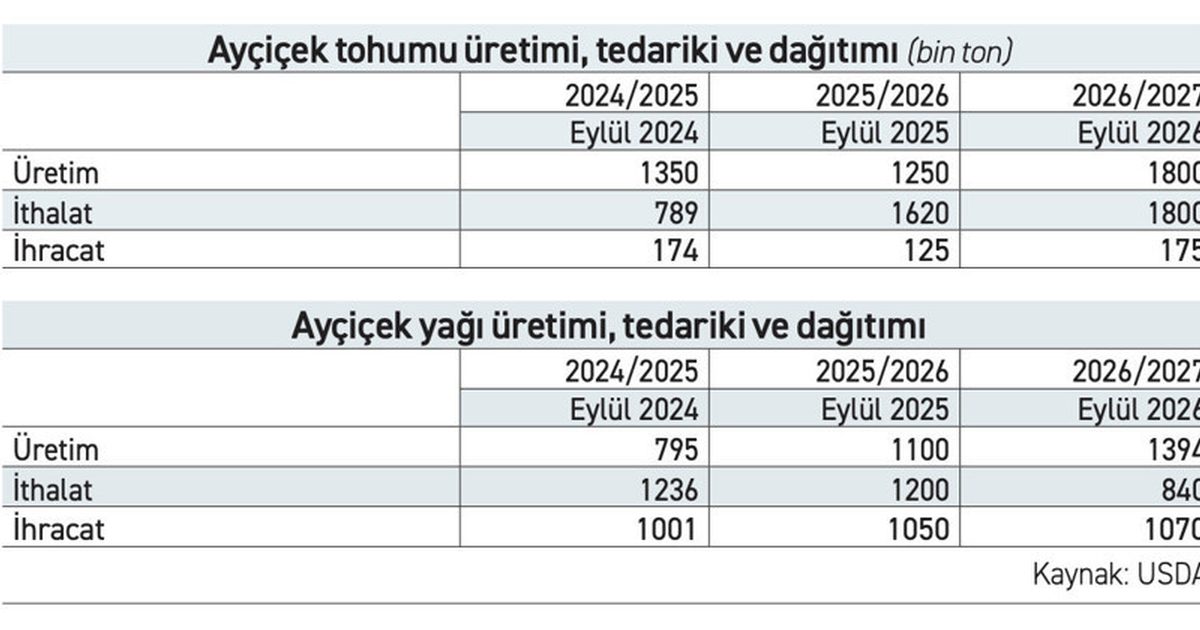
According to a report by the Ministry of Agriculture and Forestry's Agricultural Economics and Policy Development Institute, 1.9 million tons of production were obtained from 996 thousand hectares of cultivated land in the 2025/2026 season. TÜİK's First Estimate of Plant Production indicates that the 2026 harvest is expected to reach 2.3 million tons, a 16.2% increase. While Turkey ranks 7th in exports, 1.3 million tons of seeds were imported and 93 thousand tons were exported during the first 8 months of the same season. Self-sufficiency fell to 63% in 2024/2025.
Turkey's share in global sunflower imports climbed to 44.5% in the 2025/2026 season, up from 30.2% in the 2024/2025 period. A significant portion of these raw materials are processed and exported as vegetable oil. On the other hand, there is a difference of 500-600 thousand tons between TÜİK data and industry estimates. The Turkey Oilseeds and Products Semi-Annual Report published by the U.S. Department of Agriculture also presents current indicators that differ from local statistics, documenting the divergence within the sector.
| Value | Period | Measure |
|---|---|---|
| 70% | Current | Dry farming rate |
| 30% | Current | Irrigated farming rate |
| 996 thousand hectares | 2025/2026 | Planting area |
| 1.9 million tonnes | 2025/2026 | Production amount |
| 16.2% | 2026 | Estimated production increase |
| 2.3 million tonnes | 2026 | Estimated production amount |
| 7 ranks | 2025/2026 | Export rank |
| 1.3 million tonnes | 2025/2026 | Seed import (8 months) |
| 93 thousand tonnes | 2025/2026 | Export amount (8 months) |
| 63% | 2024/2025 | Self-sufficiency rate |
| 30.2% | 2024/2025 | Share in world imports (old) |
| 44.5% | 2025/2026 | Share in world imports (new) |
| 500-600 thousand tonnes | Annual | Inter-institutional forecast difference |