


Record Fruit Production Despite Challenges: Turkish Exporters Struggle in Global Competition
· Tarım Dünyası
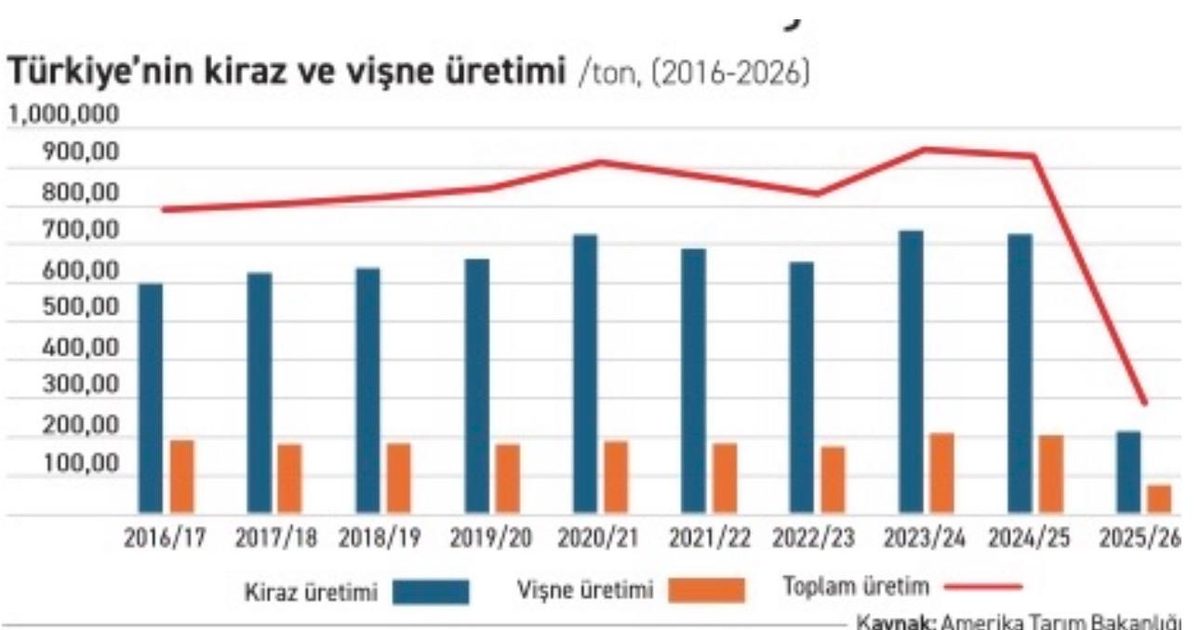
While Turkey's stone fruit harvest reaches historic levels, high input costs and a suppressed exchange rate are limiting the competitiveness of producers and exporters in the global market.
USDA Report Examines Stone Fruits
The United States Department of Agriculture (USDA) conducted a detailed examination of the fruit sector in Turkey with its comprehensive "Turkey: Stone Fruit Annual Report" published on August 27, 2026. The report highlighted that production has reached a historic record level following severe natural disasters in the previous marketing year. However, it was noted that despite the massive increase in production, producers and exporters are facing significant challenges in global competition.
The USDA made the following assessment regarding the sectoral outlook within the scope of the USDA Report Presentation:
"Cherry production is expected to increase by approximately 250% to 1 million tons, while peach and nectarine production is projected to nearly double to 1.2 million tons. This increase has significantly boosted domestic consumption by reducing consumer prices by about 50%, despite ongoing inflation and the depreciation of the lira. However, due to high input costs and a low-value lira, Turkish producers are struggling to compete with Spain, Italy, Iran, and other rivals, even as exports of fresh cherries and peaches/nectarines recover from last year's low levels."
From Severe Climate Shock to Historic Recovery
Severe meteorological fluctuations experienced in the 2025/2026 season across Turkey caused significant damage to fruit orchards. The USDA report recalled that the frost disaster in March and April 2025, affecting a total of 36 provinces, was the most devastating natural event in the last 30 years. However, favorable weather conditions in the 2026/2027 season rapidly propelled production to its peak.
The USDA Report Text included the following statements regarding yield projections:
"This is an all-time record. In the 2025/2026 season, extreme weather conditions occurred; drought, frost, excessive rainfall, and hail severely impacted production. Severe frost occurred in March and April 2025. The frost affected 36 provinces and caused significant losses in stone fruit production. Last year's frost was described as a natural disaster and the most severe frost the country has experienced in the last 30 years. Following last year's very poor yield, this year's production is expected to be at its highest level in the last 5 years due to favorable weather and soil conditions. Total cherry production for the 2026/2027 marketing year is estimated at 750,000 tons, and sour cherry production at 250,000 tons. This estimate is based on discussions with producers and is consistent with TÜİK (Turkish Statistical Institute)'s total production projections."
High Cherry Yields with Improved Varieties
USDA experts pointed out that over 100 cherry varieties are produced in Turkey, noting that the modernization of orchard structures is increasing yield potential. The proliferation of quality varieties suitable for domestic and international logistics is expanding the sector's commercial volume.
USDA Report Text data detailed variety breeding and modern plantations as follows:
"The most popular variety is the Napoleon cherry, known locally as ‘0900 Ziraat’. It is a large, juicy, heart-shaped cherry with a longer shelf life compared to other varieties, making it ideal for long-distance domestic and international shipments. Over the past 10 years, Turkish scientists have developed higher-yielding and better-quality Napoleon cherries, and growers have gradually replaced older varieties with newer, improved versions. In addition to Napoleon cherries, growers have also begun experimenting with other high-yield cherry varieties such as Early Burlat, Van, Bing, Vista, Noir De Guben, Noble, Lamber, Sweetheart, Celeste, Early Lory, Kordia, Regina, and Stella."
Pressure from Labor and Input Costs
Despite the record leap in production volume, the profitability of agricultural enterprises is shrinking due to rising costs. Fertilizer, energy, and especially harvest-period labor expenses are the primary factors suppressing producers' net income.
The USDA Report Text conveyed the on-field cost pressure with the following data:
"Labor constitutes the largest share of total input prices, ranging between 1700-2000 TL ($35.60-41.88) per day. Faced with these high costs, some producers, especially small businesses, are struggling to remain profitable."
Rising agricultural daily wages under inflationary pressure continue to strain producer budgets in high-tonnage harvests.
Exchange Rate Barrier in Cherry Exports
Although Turkey is one of the global leaders in fresh cherry production, it can only export a small portion of its total production. While fresh cherry exports are expected to increase to 80,000 tons in the 2026/2027 season, implemented monetary policies and the exchange rate level are limiting price flexibility in international markets.
The USDA Report Text listed the barriers to cherry foreign trade as follows:
"In parallel with the significant increase in production, fresh cherry exports are estimated to rise to 80,000 tons for the 2026/2027 marketing year. In the 2025/2026 marketing year, fresh cherry exports fell to 6,344 tons due to extreme weather conditions; this figure was well below the 10-year average of 72,000 tons for fresh cherry exports. Turkey, with an average annual production of 700,000 tons, is one of the world's largest fresh cherry producers, yet only 60-70,000 tons of this massive volume are exported. High input costs, combined with an exchange rate that has remained low relative to inflation, have made Turkish producers less competitive in international markets. In the last two years, the Turkish Central Bank's efforts to stabilize inflation by applying downward pressure on the dollar exchange rate have further eroded the competitiveness of Turkish cherry producers in foreign markets. With a weaker exchange rate, producers are struggling to cover their production costs with the prices offered in export markets. In the 2025/26 marketing year, the top three markets for Turkey's cherry exports were Germany, Russia, and Norway. Meanwhile, Spain, Italy, and Iran, Turkey's main competitors in cherry production, took advantage of Turkey's production decline last year to offer their cherries at more competitive prices. This year, exceptionally high production in competing countries has intensified price competition in the global fresh cherry market, making it increasingly difficult for Turkish producers to sell their fruits abroad."
Modern Orchards for Peaches and Nectarines
Planting techniques and modern orchard investments implemented in recent years in peach and nectarine production have rapidly increased productivity. High yields are being achieved without expanding peach acreage, while both tree numbers and planting areas for nectarines continue to grow.
Modern orchards, particularly concentrated in the Mersin province, combined with the logistical advantage of the Mersin Port in the Mediterranean basin, have strengthened the export-oriented infrastructure. Total peach and nectarine production is projected to reach a record 1.2 million tons in the 2026/2027 period. This figure represents an 87% increase compared to the previous season's harvest of 642,300 tons.
Boom in Peach and Nectarine Consumption
The increased yield has created a surplus in the domestic market, significantly boosting domestic consumption of the produce. According to the USDA report, domestic peach and nectarine consumption is expected to reach 1 million tons in the 2026/2027 marketing year, an 82% increase from the previous year's level of 555,627 tons.
The USDA Report Text presented data on industrial and retail consumption habits as follows:
"In recent years, nectarine consumption has increased significantly, driven by consumers' interest in trying new and fresh fruits and adopting healthier diets. The majority of peaches and nectarines are consumed fresh. Approximately 15% of peaches are used in juice production. Turkish consumers prefer peach, cherry, and apricot nectars containing 25-99% fruit concentrate. While nectars are very popular, there is also a growing trend towards 100% fruit juices. Peaches are also used in canned products, jams, and sold frozen."
Field Prices Drop to Cost Levels
The abundant supply of produce has halved fruit prices on market stalls amidst an environment where general food inflation is around 37% and the dollar exchange rate has increased by 18%. The report noted that the selling price of peaches and nectarines to farmers remained between 15-20 TL ($0.21-0.42) per kilogram.
In contrast, peaches are sold at 60-100 TL and nectarines at 70-100 TL in retail. Farmers state that their production costs are 18-20 TL per kilogram, and the prices of 15-20 TL at the field level do not yield any profit, meaning the cheaper fruit for the consumer translates to unprofitability for the producer.
Support Insufficient for Peach and Nectarine Exporters
According to USDA estimates, peach and nectarine exports are projected to increase to 200,000 tons in the 2026/2027 season. However, export revenues are insufficient against input costs, limiting the pace of foreign sales.
The 3% Foreign Exchange Conversion Support offered by the Central Bank of the Republic of Turkey (CBRT) to exporters is insufficient to compensate for the losses arising from the exchange rate's movement against the Turkish lira. As exporters cannot alleviate the increasing cost pressure, their profit margins remain very weak in foreign markets despite record production.
Intensifying Export Competition in the Global Market
While Turkey maintains its position among the top ten countries in peach and nectarine exports, competition is increasing in traditional markets such as Russia, Romania, Ukraine, and Iraq.
The USDA Report Text summarized the competitive conditions in foreign markets as follows:
"For the past 10 years, Turkey's fresh peach and nectarine exports have shown a steady increase, except for the 2025/2026 marketing year due to extreme weather conditions. In the last 5 years alone, exports have more than doubled as Turkish producers expanded their production to meet increasing domestic and international demand. In the 2025/2026 marketing year, the main markets for Turkish peaches and nectarines were Russia, Romania, Ukraine, and Iraq. Turkey continues to be among the world's top ten countries in fresh peach and nectarine exports. In the 2026/2027 marketing year, sharp increases in fresh peach and nectarine production among Turkey's main trade rivals, including Spain, Greece, and Italy, have created an additional obstacle to Turkish exports. Another factor exacerbating this challenge is that countries like Uzbekistan and Azerbaijan have heavily invested in peach and nectarine production in recent years, gradually increasing their share in Turkey's traditional export markets."