


New Standards Take Effect for Meat and Dairy Products
· Tarım TV
The Ministry of Agriculture and Forestry has implemented new production and labeling criteria by making comprehensive changes to its regulations, aiming to prevent imitation, adulteration, and consumer deception in meat and dairy products.
The Ministry of Agriculture and Forestry has made comprehensive changes to its meat and milk product regulations to ensure food safety and provide accurate consumer information. New communiqués, published in the Official Gazette and now in effect, have completely revamped the production criteria for drinking milk and meat products. Minister of Agriculture and Forestry İbrahim Yumaklı announced that the regulations are aimed at preventing unfair competition in the market. These new rules will maintain quality standards in animal-derived foods while strengthening legal oversight against fraudulent practices, thereby ensuring transparency in the staple foods reaching our tables.
With the new regulation, intermediate fat content ranges and confusing labeling in drinking milk have been entirely eliminated. According to the Ministry's statement, drinking milk offered to the market will now only be available in four main categories: full-fat, fatty, semi-fat, and skimmed. Minister of Agriculture and Forestry İbrahim Yumaklı made the following assessment on the matter:
Consumer rights have been protected by this step.
With the amendment to the Turkish Food Codex Communiqué on Drinking Milks, the previously existing definition of 'milk-based beverage' has been completely removed from the text. Minister of Agriculture and Forestry İbrahim Yumaklı explained the rationale behind the regulation with the following words:
Within the scope of the communiqué amendment, very clear quotas have been introduced for the first time regarding the content of flavored and seasoned drinking milks. According to the Ministry of Agriculture and Forestry data, it is now mandatory for seasoned drinking milks to contain at least 1% seasoning by mass. The amount of added sugar allowed in drinking milks has been limited to a maximum of 5% by mass, with a total sugar content of 9.5%. Furthermore, the addition of glucose and fructose syrups to milk has been prohibited, with only white sugar derivatives within the scope of the Turkish Food Codex Communiqué on Sugars being permitted.
Oversight has been increased on the statements made on the packaging of drinking milks to prevent misleading labeling. Minister of Agriculture and Forestry İbrahim Yumaklı made the following statements regarding labeling requirements:
The term 'natural' will only be allowed on full-fat and fatty milk products. Additionally, only natural flavorings will be permitted in products instead of artificial sweeteners.
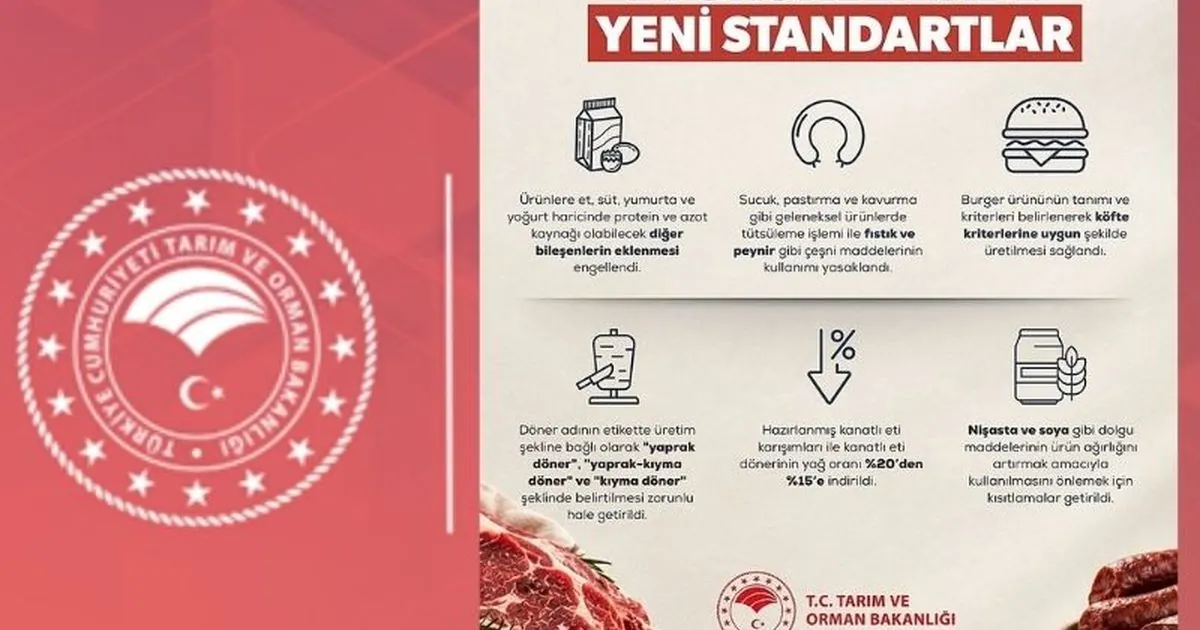
With the Turkish Food Codex Communiqué on Meat, Prepared Meat Mixtures, and Meat Products published in the Official Gazette, strict rules to prevent imitation and adulteration in meat products have come into effect. The addition of any external protein or nitrogen source, other than meat, milk, eggs, and yogurt, to raw meat, minced meat, and prepared meat mixtures has been completely prohibited. Severe restrictions have been imposed on fillers like soy and starch, which are used to artificially increase product weight. Burger products are now required to be produced in accordance with köfte (meatball) criteria.
The traditional production processes of products with high geographical value, such as sucuk, pastirma, and kavurma, which are indispensable flavors of Anatolian cuisine, have been brought under protection. The application of smoking processes and the addition of foreign flavorings like pistachios or cheese in these traditional meat products have been prohibited by regulation. Officials from the Ministry of Agriculture and Forestry stated that this decision aims to prevent the distortion of the original structure of traditional flavors. Thus, the prevention of the degradation of traditional flavors through industrial manipulation and the delivery of original products to consumers have been legally guaranteed.
A new classification and labeling standard has been introduced for döner, one of the most consumed ready-to-eat meat products on the market. According to the Ministry's decision, businesses will be required to clearly label döner products according to their production method as 'yaprak döner' (leaf döner), 'yaprak-kıyma döner' (leaf-minced döner), or 'kıyma döner' (minced döner). Consumers will directly see what they are eating.
Within the framework of healthy eating criteria, significant reductions have been made in the fat content of poultry meat products. According to the new standards announced by the Ministry, the upper limit for fat content in prepared poultry meat mixtures and chicken döner has been lowered from 20% to 15%. Minister of Agriculture and Forestry İbrahim Yumaklı made the following statement on the matter:
In line with the new meat and milk communiqués that have come into effect, a specific compliance timeline has been provided to all food businesses operating in the sector. Industrialists and food businesses actively producing in the market before the publication of the communiqués must achieve full compliance with the regulatory provisions by March 31, 2027. Minister Yumaklı emphasized that inspections will continue resolutely after this period. Legal sanctions will be applied to businesses that do not update their production lines, recipes, and label designs by the specified date, thereby safeguarding food safety standards.
Ratio Standards Determined in Meat and Milk Communiqués
Ministry of Agriculture and Forestry
- Old Milk-Based Beverage Minimum Milk Ratio
- 50%
- Chicken Doner Old Fat Upper Limit
- 20%
- Poultry Doner New Maximum Fat Ratio
- 15%
- Drinking Milks Maximum Total Sugar Ratio
- 9.5%
- Drinking Milks Added Maximum Sugar Ratio
- 5%
- Flavored Drinking Milks Minimum Flavor Ratio
- 1%